LNA SYSTEM INFO AND SUCH

The Aeterna
System

Single star, Six planets, Our cradle world and the one and only name we care about

Everything LNA High Command has made public to its assets

Open map
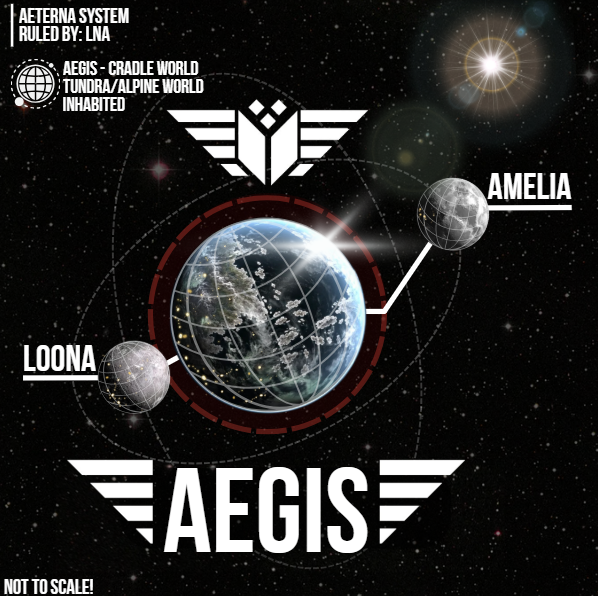
Aegis, its moons Loona and Amelia, and LNA insignia
AEGIS - MEGACORP HOME WORLD

INTERACTIVE MAP

OFFICIAL STUFF

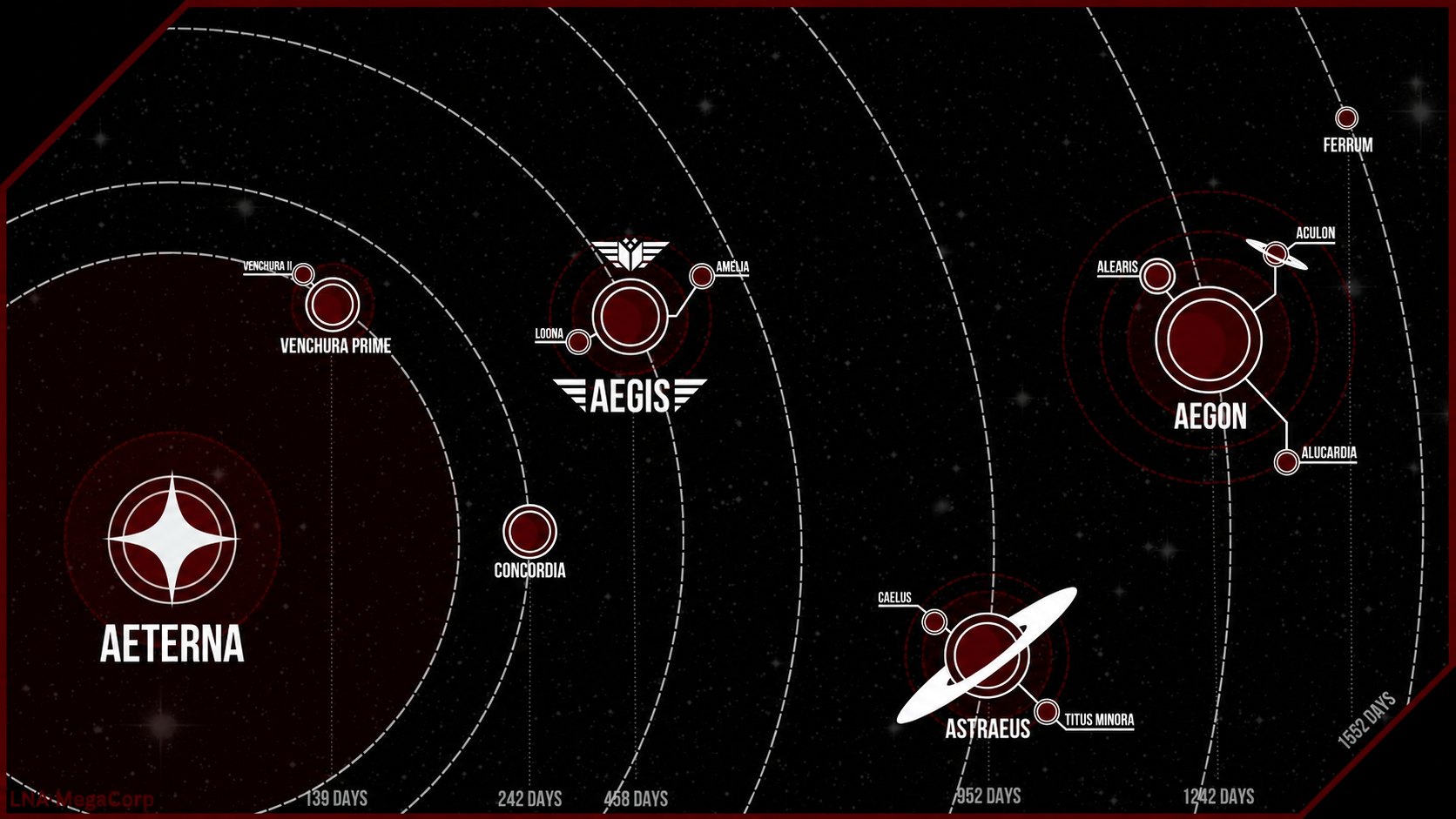
Survey our system

Select a world on the LNA chart to open its public briefing and full astronomical record

View full-size chart

On smaller screens, swipe the chart horizontally. The astronomical records are listed below.

SYSTEM BRIEFING

A corporate home among the stars

The map and astronomical records are not to scale

The Aeterna System is considered to be the core of all LNA business. Centred around its single host star, the system contains several terrestrial planets, gas giants, mineral deposits, and habitable worlds.

Aegis, the cradle world of LNA, is the primary administrative, industrial, and military centre of the system (as we only inhabit a single planet for now). It is a cold tundra/alpine world, as it resides at the outer edge of Aeterna's habitable zone. It also has two moons named "Loona" and "Amelia" - If you have questions, you aren't allowed to ask them.

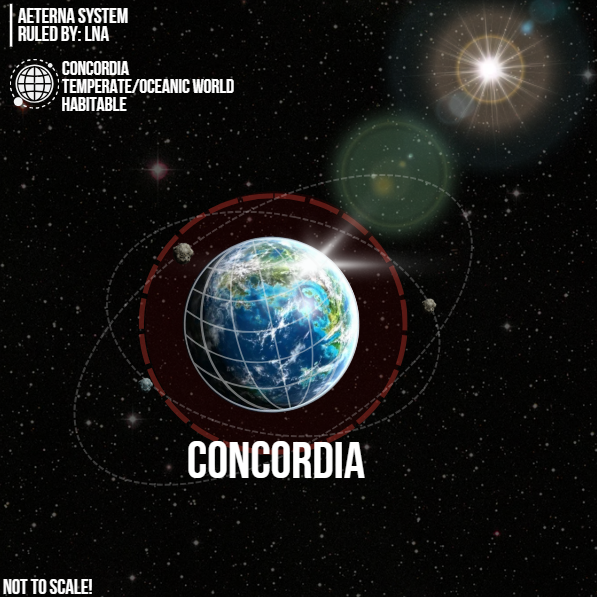
Concordia is a planet that lies closer to its host star. It supports a temperate and oceanic climate, much like Earth. We are looking forward to expanding here.

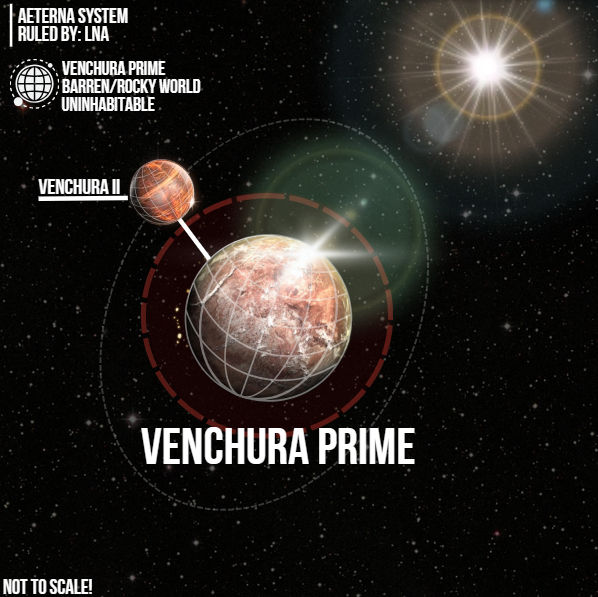
Venchura Prime on the other hand is the planet that lies closest to Aeterna. This world is considered to be a rocky/desert world. Life is possible but it is harsh.

Further out into space lies the Kronoss Belt, an extensive asteroid field separating the inner planets from the outer gas giants

Both gas giants, Astraeus and Aegon, lie beyond this belt. One has rings, while the other emits its own heat, allowing for a habitable moon.

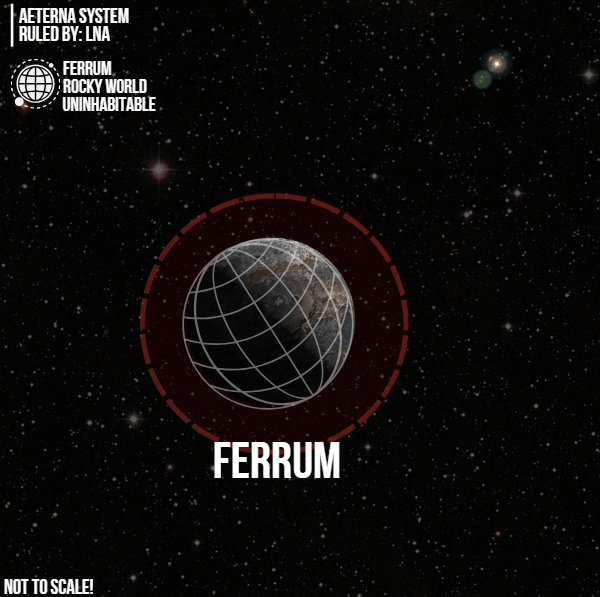
At the edge of the system lies Ferrum, a resource rich planet that supports some form of life, although we are not yet sure what kind. Our system scanners aren't that advanced at the moment.

ASTRONOMICAL RECORDS

SEVEN FILED BODIES

The full register

Official system descriptions and all published measurements from the supplied LNA record. Values are retained as filed by High Command.

Central star

Aeterna

The system’s single K2V star and the source of its orange-golden light
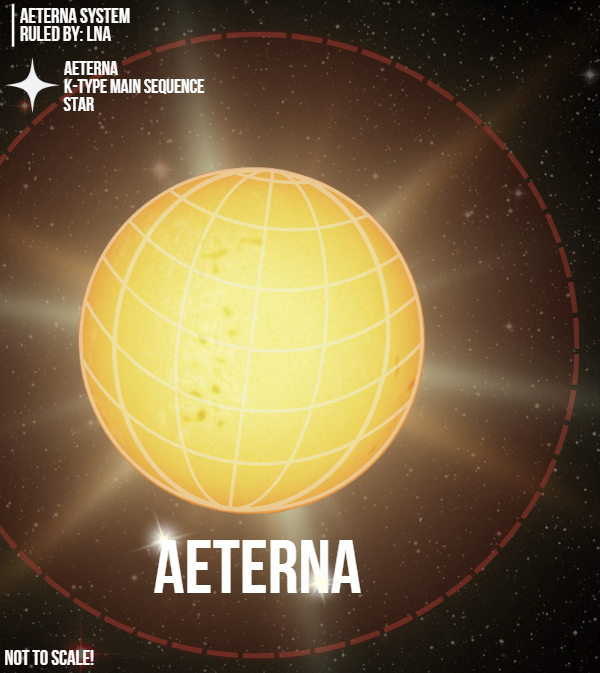
Supplied artwork of Aeterna
AETERNA / SUPPLIED SYSTEM ARTWORK
Spectral Classification
K2V
Surface Temperature
4,900 K
Estimated Age
5.2 Billion Years

Aeterna is a single K-type main sequence star at the centre of the Aeterna System. Smaller and a little cooler than the star we all know and love: Sol, it emits less heat and an orange-golden light instead of Sol's yellow-white glow.

Despite its smaller size, Aeterna provides enough energy to sustain life on multiple worlds within its Goldilocks zone. Examples include Aegis and Concordia.

Aeterna itself is a stable star, according to our astronomers, with an expected lifespan spanning billions of years, most likely outliving Sol

For LNA, Aeterna is more than just a star. It is our home.

Full astronomical specifications
Star Name
Aeterna
Star Type
Main-Sequence Star
Spectral Classification
K2V
Stellar Color
Orange/Yellow
Evolutionary Stage
Main Sequence
Surface Temperature
4,900 K
Stellar Mass
0.80 Solar Masses
Stellar Radius
0.78 Solar Radii
Stellar Diameter
1,085,000 km
Stellar Luminosity
0.40 Solar Luminosities
Surface Gravity
360 m/s
Estimated Lifespan
15 to 25 Billion Years
Estimated Age
5.2 Billion Years
Rotation Period
32 Earth days
Axial Inclination
7.2°
Rotational Direction
Prograde
Stellar Activity
Moderate
Magnetic Activity Cycle
12 Years

Inner terrestrial

Venchura Prime

A hot, rocky world with a volcanically active moon

Supplied artwork of Venchura Prime
VENCHURA PRIME / SUPPLIED SYSTEM ARTWORK
Orbital Distance
0.487 AU
Orbital Period
139 Earth days

Venchura Prime is a hot, rocky terrestrial planet and the innermost known world of our star system. Orbiting Aeterna once every 139 Earth days, the planet experiences intense sunlight, high surface temperatures and an unforgiving desert environment in which no asset can thrive.

Despite its harsh conditions, Venchura Prime is not entirely uninhabitable to asset life. Its thin atmosphere, extreme daytime temperatures, and dust storms make survival difficult without specialised protective equipment. Asset exploration is possible, although prolonged exposure to the planet's surface without adequate protection will result in the asset's early retirement.

Much of Venchura Prime's surface consists of deserts, rocky highlands, impact craters, and extensive mountain ranges. Water is extremely scarce, with most remaining deposits believed to exist beneath the surface in the form of ice or deep underground reservoirs.

The planet has one known natural satellite, Venchura II, a volcanically active lava moon. Its surface is dominated by molten rock, volcanic plains, and constant geological activity, making it one of the most hostile celestial bodies in the system while also being very resource rich.

Full astronomical specifications
Planet Name
Venchura Prime
Planet Type
Terrestrial
Primary Environment
Barren / Rocky
Other Environments
Mountain Ranges, Canyons, Volcanic Highlands, Polar Deserts
Diameter Relative to Earth
0.90x
Diameter
11,470 km
Radius
5,735 km
Mass Relative to Earth
0.72x
Surface Gravity
8.72 m/s
Orbital Period
139 Earth days
Rotation Period
30 Earth hours
Orbital Distance
0.487 AU
Inclination
11.5°
Rotational Direction
Prograde
Average Surface Temperature
31°C
Daytime Temperature
45°C to 75°C
Nighttime Temperature
-25°C to 5°C
Atmospheric Density
0.42 atm
Atmospheric Composition
Primarily CO2 and Nitrogen, trace gases
Surface Water
Limited
Natural Satellites
1 > Venchura II
Mineral Resources
Iron, Silicates, Sulphur, Rare Metals

Habitable world

Concordia

A temperate oceanic world identified for future expansion

Supplied artwork of Concordia
CONCORDIA / SUPPLIED SYSTEM ARTWORK
Orbital Distance
0.706 AU
Orbital Period
242 Earth days
Surface Temperature
16°C

Concordia is a habitable terrestrial planet located within the Goldilocks zone of the Aeterna System. Orbiting its host star once every 242 Earth days, Concordia is a temperate, oceanic world with vast bodies of water, continental landmasses, and a climate remarkably similar to that of Earth.

Unlike the colder tundra and alpine environments found on Aegis, Concordia experiences a milder climate. Large oceans cover much of its surface, regulating global temperatures and supporting an water cycle. Its continents feature dense forests, expansive grasslands, mountain ranges, and fertile coastal regions, making the planet a promising candidate for future asset settlement.

Concordia also has three large, resource rich asteroids. Although these celestial bodies are often found relatively close to the planet, one thing to note: surveys indicate lots of deposits of valuable metals and minerals, making them particularly interesting for future mining operations by our precious corporation

Full astronomical specifications
Planet Name
Concordia
Planet Type
Terrestrial
Primary Environment
Temperate / Oceanic
Other Environments
Forests, Grasslands, Mountains, Coastal Regions, Polar Ice, Small Deserts
Diameter Relative to Earth
1.04x
Diameter
13,250 km
Radius
6,625 km
Mass Relative to Earth
1.08x
Surface Gravity
9.78 m/s
Orbital Period
242 Earth days
Rotation Period
25 Earth hours
Orbital Distance
0.706 AU
Inclination
21.4°
Rotational Direction
Prograde
Surface Temperature
16°C
Equatorial Temperature
22°C to 32°C
Polar Temperature
-25°C to 5°C
Atmospheric Pressure
1.08 atm
Atmospheric Composition
Nitrogen (77%), Oxygen (22%), Trace Gases (1%)
Breathable Atmosphere
Yes
Asset Habitability
Habitable
Nearby Major Asteroids
3
Geological Activity
Moderate
Mineral Resources
Iron, Nickel, Copper, Titanium, Rare Metals

Inhabited cradle world

Aegis

LNA’s administrative, industrial, and military centre

Supplied artwork of Aegis
AEGIS / SUPPLIED SYSTEM ARTWORK
Orbital Distance
1.078 AU
Orbital Period
458 Earth days
Surface Temperature
-4°C

Aegis is a habitable terrestrial planet located near the outer edge of the Goldilocks zone of Aeterna . Orbiting it once every 458 Earth days, Aegis is a cold tundra and alpine world with vast mountain ranges, frozen landscapes, extensive oceans, and a climate considerably colder than that of Earth.

Aegis is the cradle world of LNA and serves as our primary administrative, industrial, and military centre. Despite its cold climate, the planet supports asset life with a breathable atmosphere and a lot of natural resources. Its continents feature dense coniferous forests, snowy mountain ranges, tundra plains, and coastal regions, making it a suitable home for our corporation and its assets.

One particularly interesting feature of Aegis is its small desert region, which formed as a consequence of the Second Corporate Wars. Once a more hospitable environment, the region suffered extensive environmental damage during the conflict, leaving behind a dry and barren landscape that remains visible to this day.

Aegis also has two natural satellites, Loona and Amelia, both of which orbit the planet

Full astronomical specifications
Planet Name
Aegis
Planet Type
Terrestrial
Primary Environment
Tundra / Alpine
Other Environments
Oceans, Coastal Regions, Coniferous Forests, Polar Ice, Small Desert
Diameter Relative to Earth
1.20x
Diameter
15,290 km
Radius
7,645 km
Mass Relative to Earth
1.45x
Surface Gravity
9.88 m/s
Orbital Period
458 Earth days
Rotation Period
27 Earth hours
Orbital Distance
1.078 AU
Inclination
14.5°
Rotational Direction
Prograde
Surface Temperature
-4°C
Equatorial Temperature
2°C to 14°C
Polar Temperature
-45°C to -15°C
Atmospheric Pressure
1.12 atm
Atmospheric Composition
Nitrogen (77%), Oxygen (22%), Trace Gases (1%)
Breathable Atmosphere
Yes
Asset Habitability
Inhabited
Natural Satellites
2 (Loona, Amelia)
Geological Activity
Moderate
Mineral Resources
Iron, Nickel, Copper, Titanium, Rare Metals

Ringed gas and ice giant

Astraeus

A blue ringed giant of interest for valuable gases

Supplied artwork of Astraeus
ASTRAEUS / SUPPLIED SYSTEM ARTWORK
Orbital Distance
1.76 AU
Orbital Period
952 Earth days
Surface Temperature
-165°C

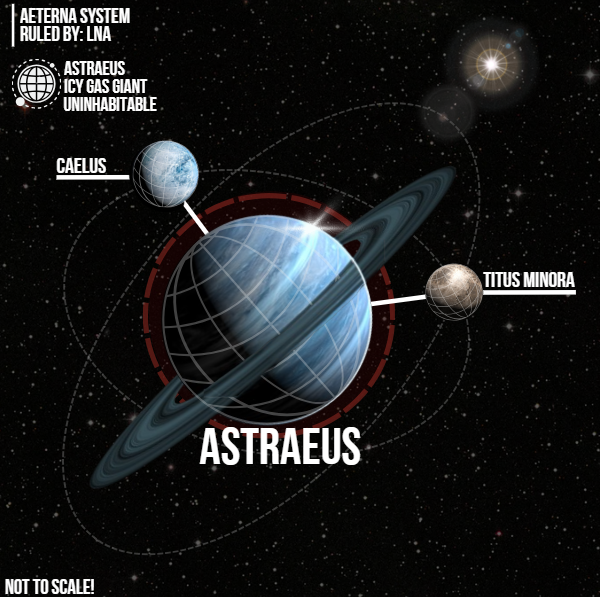
Astraeus is a blue ringed ice and gas giant located in the outer regions of the Aeterna System. Orbiting its host star once every 952 Earth days, Astraeus is a cold and interesting world with a dense atmosphere, powerful storms and a ring that makes it one of the most recognizable planets in our system.

Unlike the terrestrial worlds closer to Aeterna, Astraeus is not suitable for direct habitation. Its atmosphere is made up mostly of hydrogen, helium, and methane, giving the planet its blue color and extremely cold upper atmosphere. Strong winds and deep atmospheric pressure make surface operations impossible, although the planet remains of high interest because of it's valuable gasses used by LSF Starships.

Astraeus has two known natural satellites. The first is Caelus, an icy moon with a frozen surface and harsh temperatures. The second is Titus Minora, a rocky moon with a rough and cratered surface. Together with its ring system, these moons make Astraeus an important outersystem body for observation, future mining interest, and general asset monitoring!

Full astronomical specifications
Planet Name
Astraeus
Planet Type
Gas Giant / Ice Giant
Primary Environment
Icy Gas Giant
Other Environments
Ring System, Upper Atmospheric Storm Bands
Diameter Relative to Earth
7.50x
Diameter
95,570 km
Radius
47,785 km
Mass Relative to Earth
52.00x
Surface Gravity
9.06 m/s
Orbital Period
952 Earth days
Rotation Period
15 Earth hours
Orbital Distance
1.76 AU
Inclination
18.2°
Rotational Direction
Prograde
Surface Temperature
-165°C
Equatorial Temperature
-150°C to -135°C
Polar Temperature
-180°C to -160°C
Atmospheric Pressure
Extreme
Atmospheric Composition
Hydrogen, Helium, Methane, Trace Gases
Natural Satellites
2 (Caelus, Titus Minora)
Storm Activity
Moderate to High
Mineral Resources
Helium, Hydrogen, Volatile Compounds

Super gas giant

Aegon

The largest known planet, producing substantial internal heat

Supplied artwork of Aegon
AEGON / SUPPLIED SYSTEM ARTWORK
Orbital Distance
2.10 AU
Orbital Period
1,242 Earth days

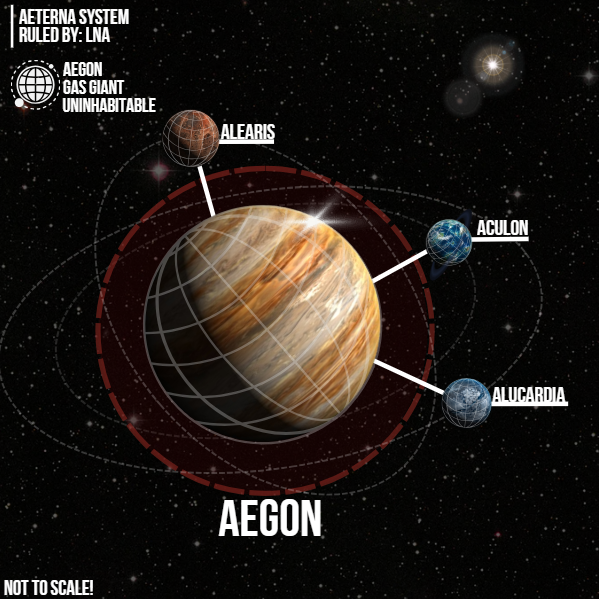
Aegon is a massive gas giant located in the outer regions of the Aeterna System. Orbiting its host star once every 1,242 Earth days, Aegon is the largest known planet in our system. Its atmosphere consists of enormous cloud formations, powerful storms, and dense layers of hydrogen and helium, giving the planet its distinctive golden/brown appearance.

Unlike the other gas giant, Astraeus, Aegon produces a great amount of internal heat. This energy is released into space, making Aegon an unusual celestial body within our system. Despite its enormous size and hostile atmospheric conditions, the planet itself remains completely uninhabitable for asset life.

Aegon has three known moon. The first is Alearis, a rocky moon with a barren surface and extensive mineral deposits. The second is Aculon, a habitable moon with oceans, continental landmasses, and a climate suitable for asset life. The third moon, Alucardia, is an icy world covered in frozen landscapes and deep surface fractures.

Full astronomical specifications
Planet Name
Aegon
Planet Type
Super Gas Giant
Primary Environment
Gas Giant
Other Environments
Atmospheric Storm Bands, High Pressure Gas Layers, Upper Atmospheric Clouds
Diameter Relative to Earth
13.20x
Diameter
168,200 km
Radius
84,100 km
Mass Relative to Earth
795.00x
Surface Gravity
35.8 m/s
Orbital Period
1,242 Earth days
Rotation Period
10 Earth hours
Orbital Distance
2.10 AU
Inclination
5.8°
Rotational Direction
Prograde
Atmospheric Temperature
-110°C
Equatorial Temperature
-95°C to -80°C
Polar Temperature
-130°C to -110°C
Atmospheric Pressure
Extreme
Atmospheric Composition
Hydrogen, Helium, Methane, Ammonia and Trace Gases
Natural Satellites
3 (Alearis, Aculon, Alucardia)
Storm Activity
High
Mineral Resources
Atmospheric Hydrogen, Helium-3, Volatile Compounds

Outer rocky world

Ferrum

A remote metallic world rich in mineral deposits

Supplied artwork of Ferrum
FERRUM / SUPPLIED SYSTEM ARTWORK
Orbital Distance
2.41 AU
Orbital Period
1,532 Earth days
Surface Temperature
-130°C

Ferrum is a small, rocky terrestrial planet located at the very edge of the Aeterna System. Orbiting Aeterna once every 1,532 Earth days, Ferrum is a cold, metallic world with a heavily cratered surface, lots of mineral deposits, and an environment harsher than those found on the inner planets.

Unlike the other terrestrial worlds within our system, Ferrum is particularly rich in valuable metals and minerals. Its surface consists of vast rocky plains, ancient impact craters, metallic highlands, and deep fractures. Large concentrations of iron, nickel, titanium, and other rare metals make Ferrum one of the most resource-rich planets currently known to the LNA. However, its remote location and extremely cold temperatures make mining operations rather challenging.

For us, Ferrum represents an enormous opportunity for future resource extraction and industrial development. Although permanent asset settlement is considered impractical, its mineral wealth makes it a valuable asset for the continued expansion of LNA.

Full astronomical specifications
Planet Name
Ferrum
Planet Type
Terrestrial
Primary Environment
Rocky / Metallic
Other Environments
Cratered Plains, Metallic Highlands, Mountain Ranges, Frozen Valleys, Polar Ice
Diameter Relative to Earth
0.65x
Diameter
8,280 km
Radius
4,140 km
Mass Relative to Earth
0.34x
Surface Gravity
7.89 m/s
Orbital Period
1,532 Earth days
Rotation Period
38 Earth hours
Orbital Distance
2.41 AU
Inclination
8.6°
Rotational Direction
Prograde
Surface Temperature
-130°C
Equatorial Temperature
-115°C to -95°C
Polar Temperature
-175°C to -145°C
Atmospheric Pressure
0.02 atm
Geological Activity
Low
Mineral Resources
Extremely High: Iron, Nickel, Titanium, Platinum, Cobalt, Chromium, Rare Metals

LNA HIGH COMMAND / PUBLIC RECORD

The frontier remains billable

Read the lore archive